
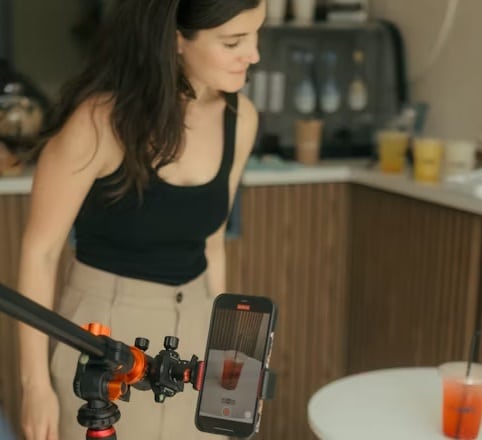
Short answer: Lo-fi doesn’t mean lazy. It means adapted. The best performing content today isn’t always the most polished; it’s the most believable.
Why lo-fi works – when it’s done with intent
Lo-fi content works not because it’s rough but because it feels honest. It mirrors how your audience creates and consumes media in their own lives. Overly polished and high-produced content is losing appeal, and audiences are looking for something they can relate to, content that feels genuine rather than disconnected from the everyday experience.
But “relatable” isn’t the same as “unplanned.”The best lo-fi content is strategically loose – it looks effortless because the thinking behind it is sharp.
For speed and relevance: Lo-fi is ideal for reactive moments, trend-led content, campaign extensions, and community engagement. It lets teams test ideas quickly without waiting for a studio slot. When a cultural moment lands on a Tuesday morning, you can be in the conversation by Tuesday afternoon.
For credibility and connection: Creator-led and employee-generated content consistently outperforms glossy brand films on trust metrics. It gives audiences a sense of proximity that no amount of production budget can manufacture. Behind-the-scenes stories and authentic human expertise are increasingly what differentiates brands in an AI-saturated content landscape
For insight and iteration: Lo-fi content is your lowest-cost testing ground. If an idea resonates in short form, it’s a strong signal to invest in a bigger, hi-fi version. Think of it as a creative proof of concept, validate first, produce second.
When Hi-Fi still earns its budget
Lo-fi isn’t a replacement for everything. There are moments where production quality isn’t just a nice-to-have, it’s the message.
Brand launches and complex storytelling still benefit from the control and clarity that hi-fi production provides. When your tone, visuals, and messaging need to align perfectly, especially across a campaign with multiple touchpoints, cutting corners on production is a false economy.
Emotional, long-form content needs time, texture, and craft to land. Some stories can’t be told in 60 seconds on a phone. If the goal is to genuinely move people, not just catch them mid-scroll, hi-fi remains the right tool.
Long-term brand assets, recruitment videos, product explainers, and brand films should still meet higher technical and creative standards. These are the pieces that work for you for 18 months. Invest accordingly.
The hybrid model: what actually works in 2026
The smartest brands aren’t choosing between lo-fi and hi-fi. They’re building content ecosystems that use both deliberately.
Here’s the framework we recommend:
Plan for both from the start. Your content strategy should map which moments call for lo-fi agility and which demand hi-fi craft. Don’t treat it as a budget decision; treat it as a creative one.
Set standards for each format, not just the output. Define what “good” looks like across both styles in terms of tone, message clarity, and audience intent. Lo-fi content still needs a brief.
Use lo-fi as your feedback loop. Test concepts quickly in short form. When something sticks – strong watch time, saves, shares, comments, that’s your signal to invest in a hi-fi version that can scale it.
Measure what actually matters. Engagement, likes, and views aren’t meaningful outcomes on their own; the important benchmarks now are ROI and brand-building metrics. Track watch time, saves, and conversions over surface-level metrics like production quality or ad spend.
Empower your people to create. Internal creators and brand partners can produce native-feel content that no external shoot can replicate, but they need clear guardrails on brand voice, visual identity, and messaging boundaries. Freedom within a framework, not a free-for-all.
The bottom line
AI-generated content is flooding digital channels, which means that being genuinely human is now one of the most powerful assets a brand has. Lo-fi content, done with intention, is one of the most effective ways to signal that humanity.
But “lo-fi” is not a licence to be lazy. It’s a creative commitment to authenticity, one that still requires strategy, brand clarity, and an understanding of your audience.
The brands winning on social right now aren’t the ones with the biggest production budgets. They’re the ones who know which story to tell, and which format to tell it in.
Want to explore how lo-fi and hi-fi can work together in your content strategy? Get in touch with the Hurricane Social team.